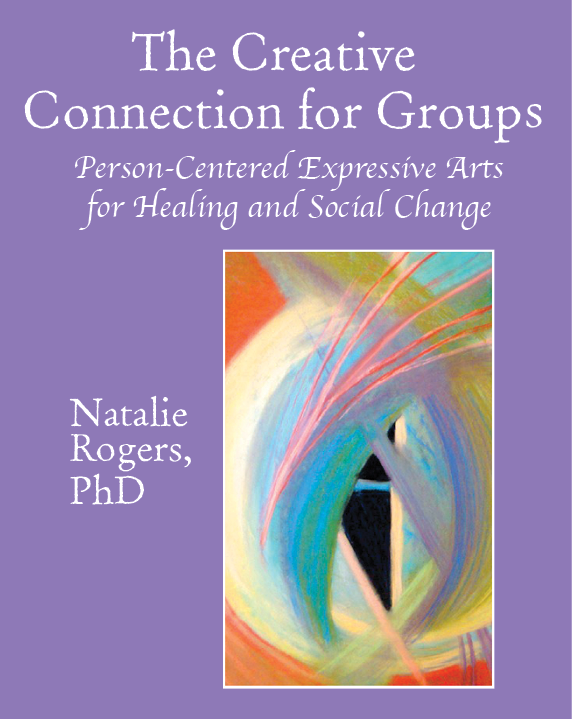
Product Description
Natalie Rogers does a marvelous job of describing what it takes to become an effective facilitator of a person-centered group. . . . This work will be useful for group practitioners, regardless of their theoretical orientation. She reminds us that what counts is not the techniques we use; rather, it is our way of being that is crucial in creating safety in a group that allows people to take risks.
Marianne Schneider Corey, MA, MF
Groups: Process and Practice (8th ed.)
This powerful book is filled with useful ways people can gain self-awareness through expressive arts. It is a significant contribution to the literature on group counseling, as it extends the foundation of person-centered therapy. Dr. Rogers’s style of writing is personal, clear, and inviting.
Gerald Corey, EdD, ABPP
Diplomat in Counseling Psychology, Professor Emeritus of Human Services and Counseling, California State University at Fullerton
Theory and Practice of Group Counseling (8th ed.)
I am excited to see Natalie Rogers’s decades of dedicated work and research reflected in this important new book that will benefit so many. In accessible and elegant language and images, Natalie maps pivotal principles, practices, and inspiring applications of Expressive Arts Therapy across the world community.
Daria Halprin
Founding Director, Tamalpa Institute
The Expressive Body in Life, Art and Therapy: Movement, Metaphor and Meaning
The Creative Connection for Groups is particularly relevant in times of social upheaval like ours. It joins such works as Art in Action: Expressive Arts and Social Change (ed. Ellen and Stephen Levine) in offering a way for the expressive arts to go beyond individual development toward a broader concern for the world which affects us all.
Steven Levine
Vice-Rector and Dean of the Doctoral Program in Expressive Arts, The European Graduate School
By underscoring the body in person-centered transformation, Natalie Rogers and her colleagues impact core dimensions of human well-being. This sagacious book is a must-read for all those interested in the expressive arts and in the healing and transformation of our world. It is comprehensive and illuminating!
Kirk Schneider, PhD
President of the Existential‒Humanistic Institute
Awakening to Awe and Existential‒Humanistic Therapy
Natalie’s book represents the transformation of Carl Rogers’s Client-Centered Therapy into a more subtle experiential psychology of spiritual realization. The evolution of the individual is now extended to the evolution of groups, the goal of which is nothing less than world peace through the actualization of our humanity. Natalie’s work has found a secure place in the history of humanistic psychology.
Eugene Taylor, PhD
Professor in the College of Psychology and Humanistic Studies, Saybrook University
The Mystery of Personality: A History of Psychodynamic Theories
This landmark text is for all those wishing to embrace the expressive arts in their professional work. It is particularly aimed at those wishing to advance consciousness, empathy, and creativity in group settings . . . including organizations and intercultural arenas. Natalie’s seminal work holds out inspiration, hope, and real guidance for colleagues working where there is conflict, complex history, and political forces. This is such a practical and life-enhancing book.
Colin Lago
Independent counselor, supervisor, trainer, and consultant
Editor, Handbook of Transcultural Counselling and Psychotherapy
Natalie’s new book is a marvelous treasure trove of practical wisdom, cross-cultural applications, lively illustration, and handy resources for students/practitioners/therapists involved in expressive arts groups for life transformation and empowerment.
Fiona Chang, REAT, RSW, M. Soc. Sc.
Honorary Lecturer and Founder of Person-Centered Expressive Arts Training, The University of Hong Kong
This new book will give our Japanese facilitators of Person-Centered Expressive Arts added support as we conduct our intensive training program. When our participants say it touches their souls deeply and helps them to change for the better, it makes me happy. We appreciate Natalie . . . for teaching us how to set a safe group environment to do this kind of deep work.
Kyoko Ono, MA, REAT
Licensed Clinical Psychologist. Founder and Senior Faculty of the Expressive Arts Therapy Institute, Tokyo
I find the philosophy of person-centered expressive arts truly compatible with the values that are close to the hearts of Koreans. Therapists in South Korea are interested in healing themselves before they help others. They will definitely learn what they need to experience to become a group facilitator of person-centered expressive arts through this book.
Tae Ok Jeon, MA, PATR
Founder of Dageu Art Therapy Institute Founder/Faculty of Person-Centered Expressive Arts Training, South Korea
An exceptional book. It offers the richness of the expressive arts experience for healing and growth, . . . grounded in both scholarship and years of work with diverse clients and cultures. It can help individuals and help the world.
Ruth Richards, MD, PhD
Saybrook University and Harvard Medical School
Editor, Everyday Creativity and New Views of Human Nature
For those interested in healing the human soul through art, creativity, and community, this book is a godsend. Natalie Rogers has taken the principles of her father, Carl Rogers’, therapeutic approach and applied them in the artistic realm. . . . It will, I predict, have a wide audience among those who understand that healing does not come through mechanistic techniques but through deep contact with self and others.
David N. Elkins, PhD
Past-President, Division 32, Society for Humanistic Psychology, American Psychological Association
Humanistic Psychology: A Clinical Manifesto: A Critique of Clinical Psychology and the Need for Progressive Alternatives
This comprehensive book transmits the healing qualities of Natalie’s presence and soul, along with clear steps, exercises, and examples of how to integrate Person-Centered Expressive Arts into all phases of group work. In the final chapter, the seeds Natalie planted around the world come to life through her former students, providing a rich resource . . . for cross-cultural applications in therapy, education, work, personal growth, and community settings—bringing hope, transformational healing, and peace!
Laury Rappaport, Ph.D., REAT, ATR-BC
Associate Professor, Art Therapy Department, Notre Dame de Namur University
Focusing-Oriented Art Therapy: Accessing the Body’s Wisdom and Creative Intelligence
As the world honors and emulates America’s history of creativity in education, we seem directed to dousing this flame of uniqueness. Dr. Natalie Rogers revitalizes our desire for creativity in her newest and most stunning creation. She dispels the myth of the “sage on the stage” and moves us to the “guide on the side,” as she weaves a tapestry of ideas that stretch from the theoretical to the practical in a book that is personal, aesthetic, and truly inspirational. Natalie takes us on a wonderful journey that will resonate with all who are in the caring professions.
Jerome Freiberg,
Fellow, American Education Research Association
Editor, Beyond Behaviorism: Changing the Classroom Management Paradigm
This book is a box of treasures! It will be a tremendous help in my teaching and facilitating Person-Centered Expressive Arts in Argentina.
Graciela Bottini, PhD
Founder/Director: Person-Centered Expressive Therapy Institute, Argentina
Natalie has done it again. I find especially valuable her emphasis on the connections between person-centered principles and the practice of expressive arts, offering a solid foundation for all group facilitators interested in expanding their scope by integrating nonverbal elements in their work.
Alberto Segrera, MA
Professor Emeritus, Universidad Iberoamericana, Mexico City
A profoundly helpful book about Natalie’s unique approach to expressive arts therapy, imbued with her belief in human dignity and the power of the arts to heal both individuals and society. Her clarity is matched by her creativity, a rare combination of organized thinking about inspirational processes. I thoroughly enjoyed reading it, feeling a sense of renewal about familiar yet newly framed ideas.
Judith A. Rubin, PhD, ATR-BC
Faculty, University of Pittsburgh and the Pittsburgh Psychoanalytic Center
The Art of Art Therapy
An indispensable guide for anyone working with creativity—whether with individuals, groups, or organizations. Natalie’s vision of the connection between creativity in groups and global awareness is an inspiration for our times. Her book is a treasure and will be a classic for the expressive arts.
Olivia Hoblitzelle, PhD
Ten Thousand Joys and Ten Thousand Sorrows: A Couple’s Journey Through Alzheimer’s
Natalie’s book is both engaging and enchanting. She writes from her deep fountain of wisdom and from her heart. Her book is a must-read for anyone interested in the healing power of creative expression, and the essence of the human connection.
Jeanne Achterberg, PhD
Professor, Saybrook University
Intentional Healing: Consciousness and Connection for Health and Well Being
Her approach has been tested in workshops and training programs with groups from Neve Shalom, Israel, to Santa Rosa, California; in each case opening a window of personal transformation that transcends any culture or nation. The Creative Connection is a powerful humanistic therapeutic process that takes its place alongside the model of person-centered therapy that inspired Natalie in her work.
Donald Moss, PhD
Chair of the College of Mind-Body Medicine at Saybrook University
Past President of APA Division 30
Editor, Handbook for Mind-Body Medicine for Primary Care
The worlds of psychology and art, personal and social transformation are reunited in this brilliant and wise book. Truly a legacy from a gifted and compassionate teacher, artist, and therapist.
Aftab Omer, PhD
President, Meridian University
The Spacious Center: Leadership and the Creative Transformation of Culture
When I worked with Natalie and her father in the 1980s to apply person-centered processes to the work of social transformation, her focus on the role of expressive arts was just emerging. It was obvious even then, however, that the connection between creative expression, inner work, and social action offered a powerful process for social and personal change even in situations of serious conflict and suffering. This book is the culmination of her long, dedicated inquiry into the heart of social change. I have been proud to support bringing her work into Saybrook University, where it could gain the recognition and research support it has long deserved. The theory and practice are now mature—and brilliant. The book is a tour de force.
Maureen O’Hara, PhD
President Emerita, Saybrook University, President International Futures Forum-US
The Handbook of Person-Centred Psychotherapy and Counselling
Who is not eager to open this new book of Natalie Rogers—to read how she has expanded the Creative Connection, how it has ripened through her long experience and application by so many practitioners.
Paolo J Knill, PhD, REAT
President, European Graduate School (EGS), Switzerland
Lösungskunst (Art as Solution)
Her book is a gift—aesthetic, heartwarming, and useful—to clinicians and to all of us who are hoping to discover who we are.
James S. Gordon, M.D.
Founder and Director: The Center for Mind-Body Medicine
Unstuck: Your Guide to the Seven Stage Journey Out of Depression
Natalie Rogers’s continuing commitment to healing—individuals, groups, and communities—and to facilitating social change and peace in the world continues to be impressive and inspiring.
Keith Tudor, PhD
Associate Professor, AUT University, Auckland, New Zealand
Co-author, Person-Centered Therapy: A Clinical Philosophy
Reviews
There are no reviews yet.